Quick Hit Ultra Pays Slot Machine Strategy
Quick Hit Ultra Pays is an accumulator machine. The AP edge is in the Quick Hit symbol counter that persists between sessions — not the base game RNG. When a previous player loads the counter and walks away, you inherit that accumulated value at a fraction of the cost it took to build it.
The Quick Hit Accumulator Mechanic
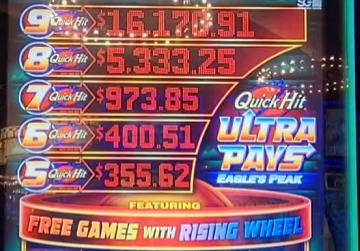
Quick Hit Ultra Pays is a Bally / Scientific Games title built around the iconic Quick Hit symbol that has appeared in the Quick Hit family for decades. In the base game, Quick Hit symbols land on the reels during normal play. In the standard Quick Hit series, these symbols contribute to scatter pays. In Quick Hit Ultra Pays, they do something more powerful: they accumulate in a persistent on-screen counter.
Each Quick Hit symbol that lands during a spin is added to the accumulator meter displayed prominently on the machine's interface. The meter tracks the total count across sessions — it does not reset when a player cashes out. It resets only when the accumulated count reaches the bonus threshold and the bonus round fires. This is the key structural feature that makes Quick Hit Ultra Pays an advantage play target.
The “Ultra Pays” bonus round triggered by the accumulator delivers an elevated payout relative to the normal base game return. The size of that payout scales with denomination — a machine running at higher denomination accumulates more absolute dollar value per symbol than a penny-denomination version. The threshold to trigger the bonus is consistent within each cabinet configuration, which is why machine-specific data on trigger thresholds is the most valuable information an advantage player can have.
Key distinction from MHB play: Quick Hit Ultra Pays is an accumulator play, not a must-hit-by progressive play. The edge comes from inherited accumulator state — not from a jackpot meter approaching a published ceiling. The identification skill is different: you are reading a symbol count, not a dollar amount on a progressive display.
When to Sit Down: Elevated Accumulator State
Floor scouting Quick Hit Ultra Pays requires reading the Quick Hit symbol counter on the machine display. The counter is visible on the attract screen or in-game interface on most cabinet variants. You are looking for a machine where the count is elevated — where a previous player has done the expensive work of feeding Quick Hit symbols into the meter — and then left before the bonus triggered.
The general AP entry threshold is 8 or more Quick Hit symbols accumulated. At that level, the remaining number of symbols needed to reach the bonus trigger represents a manageable coin-in investment relative to the bonus value stored in the meter. The strongest entry signal is a counter showing 8 to 10+ symbols on a machine that has clearly been idle — no credits in the machine, machine in attract mode, no player seated nearby with a ticket in hand.
Machine-specific trigger thresholds vary by cabinet configuration. Subscriber guides document the exact thresholds for Quick Hit Ultra Pays setups across different denominations and cabinet variants. Use the general 8-symbol floor as a screening threshold on your floor walk, then cross-reference with the specific trigger data before committing your session bankroll.
Strong entry signal
Accumulator at 8+ symbols, machine idle in attract mode, no ticket visible. This is the loaded-machine scenario — a prior player funded most of the bonus cycle and you are stepping in at the low-cost end of it.
Weak entry signal
Counter at 0 to 3 symbols after a recent bonus trigger. The expensive part of the cycle is still ahead of you. No AP edge exists here — pass and continue your floor walk.
Walk-Away Rules
The walk-away discipline for Quick Hit Ultra Pays is straightforward in theory and requires consistent execution in practice:
- Stay until the Ultra Pays bonus fires or your pre-set session stop-loss is reached. Do not leave mid-play on a loaded machine — abandoning an elevated accumulator hands your invested coin-in to the next player.
- After the bonus triggers and the counter resets, the AP edge is gone. Evaluate the new counter state — if it has reset to zero, leave immediately. There is no advantage play rationale for continuing on a fresh accumulator.
- Do not rebuy past your stop-loss to chase a counter that has not yet fired. The variance on accumulator plays can be significant, and exceeding your pre-set stop compounds losses rapidly.
- One session, one play. Quick Hit Ultra Pays accumulator plays are bounded sessions — you enter with a specific edge created by an elevated meter state, you play until that edge is realized or exhausted, and you move on. Re-entering on a reset machine is a new negative-EV decision, not a continuation of your original +EV play.
EV Calculation Framework
Calculating expected value on a Quick Hit Ultra Pays accumulator play requires knowing three inputs: the current accumulator count, the threshold to trigger the bonus, and the estimated value of the Ultra Pays bonus at the current denomination. A practical framework for the floor:
Practical EV Framework
- Read the current accumulator count. The Quick Hit symbol counter is displayed on the machine interface. Note the number and compare it to the known trigger threshold for this specific cabinet and denomination.
- Estimate symbols remaining to trigger. The difference between the current count and the trigger threshold is your remaining work. Estimate the average coin-in required to land one additional Quick Hit symbol, then multiply by the symbols remaining. This is your estimated cost-to-trigger.
- Estimate Ultra Pays bonus value. The bonus value scales with denomination. At penny, the absolute dollar value is lower but the coin-in requirement per symbol is also lower. At quarter and dollar, the absolute bonus value is proportionally larger.
- Net EV = (base return on cost-to-trigger + bonus value) — cost-to-trigger.If this is positive, the play has mathematical support. If negative, the entry threshold has not been reached — continue scouting.
Use the EV calculator as a starting point for session EV estimation. For machine-specific Quick Hit Ultra Pays trigger thresholds and denomination-specific bonus values, the subscriber guide provides the exact data needed for precise calculations.
Access all 200+ machine guides including the Quick Hit Ultra Pays subscriber guide with exact accumulator thresholds, trigger levels, and denomination-specific EV data.
View Machine GuidesFrequently Asked Questions
What is the Quick Hit Ultra Pays accumulator?+
The Quick Hit Ultra Pays accumulator is a persistent on-screen counter that tracks Quick Hit symbols collected across sessions. Each time a Quick Hit symbol lands during the base game, it is added to the meter. When the meter reaches its threshold, it triggers a bonus round with an elevated payout. Critically, the counter does not reset between players — it only resets after the bonus fires. This makes it an advantage play target: a player who builds the meter and leaves hands that accumulated value to the next person who sits down.
When is Quick Hit Ultra Pays +EV?+
Quick Hit Ultra Pays is in a +EV state when the accumulator meter shows 8 or more Quick Hit symbols already collected. At that level, the remaining cost to push the counter to the bonus threshold is a fraction of the bonus value that the previous player has already funded. The machine is most clearly +EV when the meter is between 8 and 10 symbols and the machine has been idle — meaning a prior player loaded it and walked away before the bonus triggered. Use the EV calculator to confirm the specific play at any accumulator level.
What denominations are best for Quick Hit Ultra Pays advantage play?+
Higher-denomination versions of Quick Hit Ultra Pays pay out the accumulated bonus value in proportion to the denomination played. A dollar-denomination machine accumulates more absolute bonus value per symbol than a penny-denomination machine. For advantage play purposes, the higher-denomination versions offer a larger absolute edge when the accumulator is loaded. However, the higher coin-in requirement per spin also means a larger session bankroll is needed. Penny denomination is the accessible entry point; quarter and dollar versions offer larger absolute edges at higher bankroll requirements.
Is Quick Hit Ultra Pays the same as regular Quick Hit for advantage play?+
No. Regular Quick Hit machines are standard negative-expectation games with no persistent accumulator mechanic. The AP edge on Quick Hit Ultra Pays comes entirely from the Ultra Pays accumulator layer — the visible Quick Hit symbol counter that persists between players. Standard Quick Hit does not have this feature. When scouting the floor, confirm you are looking at a Quick Hit Ultra Pays cabinet specifically, not a Quick Hit Platinum, Quick Hit Pro, or other variant in the Quick Hit family that lacks the persistent accumulator.
Ready to dig deeper? Accumulator slot machines guide or slot machine strategy overview.